Convergence of SEO, Content and Product Marketing in the AI Era
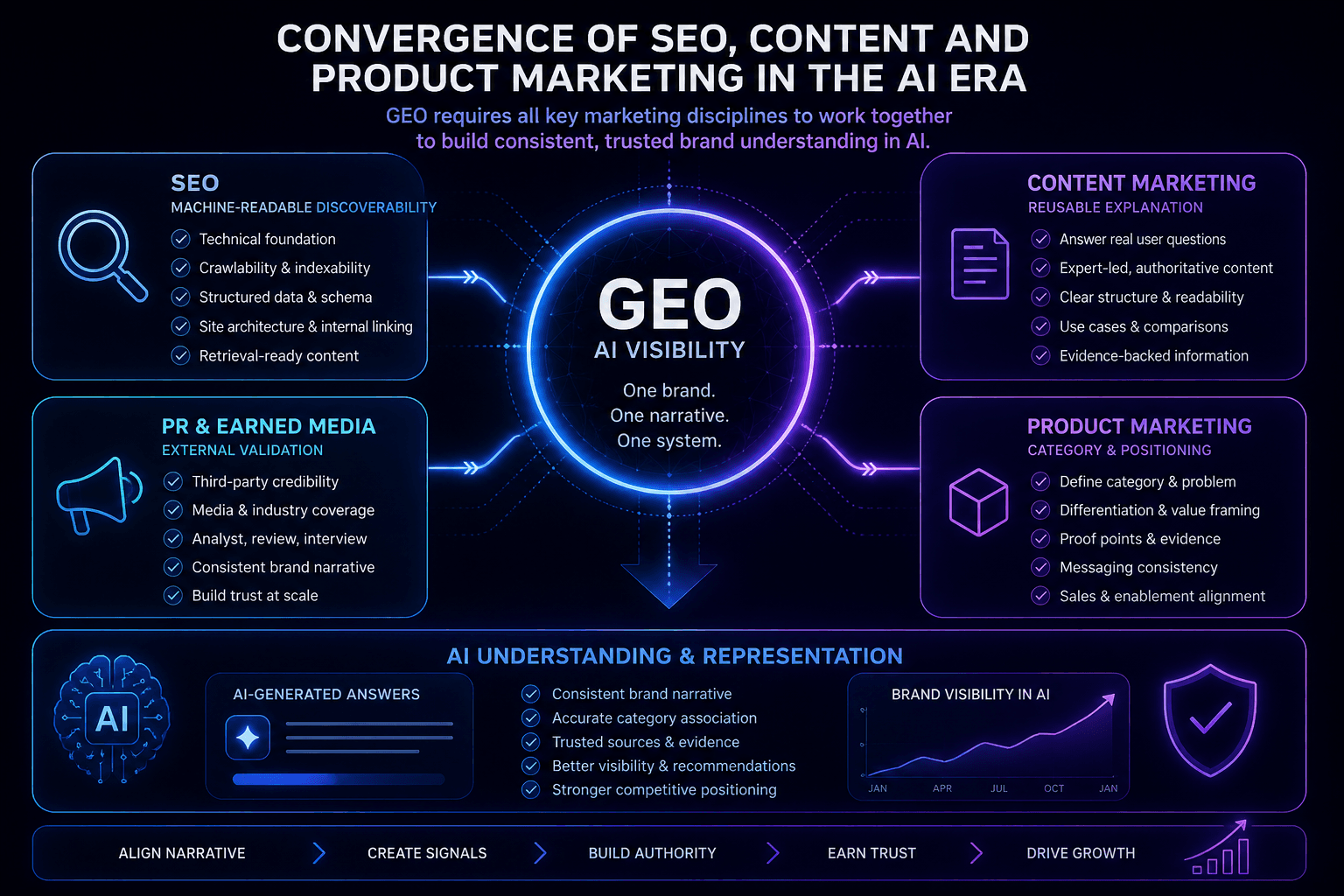
Convergence of SEO, Content and Product Marketing in the AI Era
Short answer
In the AI era, GEO does not belong to one team. It sits at the intersection of SEO, content marketing, PR, and product marketing because AI systems do not evaluate brands through one channel at a time. They absorb technical signals, on-site content, third-party coverage, positioning language, and repeated category narratives all at once.
That means the old model of isolated execution is becoming a liability. If SEO optimizes one story, product marketing tells another, PR amplifies a third, and content publishes a fourth, AI systems inherit the inconsistency. In the AI-native web, convergence is not a nice-to-have. It is a visibility requirement.
Why this matters now
For years, companies could get away with partial alignment. SEO teams focused on rankings and technical performance. Content teams focused on publishing. PR focused on earned coverage. Product marketing focused on messaging, differentiation, and sales enablement. Those functions influenced each other, but they could still operate with separate planning cycles and separate success metrics.
AI discovery changes that. When buyers increasingly rely on systems like ChatGPT, Gemini, and Perplexity to understand markets, compare vendors, and decide who to trust, those systems compress signals from across the web into one synthesized answer.
This is why convergence matters so much. AI does not care which internal team created a signal. It only sees whether the signals reinforce each other or conflict.
Why GEO cannot be owned by SEO alone
It is tempting to treat GEO as the next chapter of SEO. That is partly true, but only partly.
SEO still provides the foundation. Technical crawlability, structured content, clear page hierarchy, and strong information architecture still matter. But GEO goes further because being visible in AI-generated answers depends not only on discoverability, but also on interpretation. The system has to understand what your brand is, what category it belongs to, how it differs from alternatives, and whether enough credible evidence exists to repeat that description confidently.
That gap between discovery and interpretation is where convergence begins. SEO alone cannot solve it because the inputs are broader than site structure and rankings.
The four disciplines that now need to work as one system
1. SEO creates machine-readable discoverability
SEO remains essential because AI systems still rely on content that can be accessed, parsed, and indexed. The technical side of the website still matters. Clean HTML, strong internal linking, semantic page structure, schema, and focused topic architecture all improve the odds that your content can be retrieved and understood.
But in the AI era, SEO’s role expands beyond rank acquisition. It becomes the layer that helps make content machine-readable and retrieval-ready. SEO is no longer only about getting the click. It is about ensuring the brand can be interpreted correctly before the click ever happens.
2. Content marketing creates reusable explanation
Content marketing supplies the explanatory layer. It turns category knowledge, customer questions, use cases, comparisons, objections, and decision criteria into structured materials that AI systems can draw from.
This is especially important because AI systems tend to favor content that is clear, recent, expert-led, and evidence-backed. In other words, content is no longer just fuel for rankings. It is fuel for machine understanding.
That means content teams must think beyond volume. The goal is not to publish more pages. The goal is to publish pages that explain the brand, the problem, the category, and the solution in a way that machines can extract and reuse confidently.
3. PR builds external validation
PR contributes what owned channels often cannot provide on their own: third-party trust.
When AI systems evaluate a brand, they do not rely only on what the company says about itself. They also absorb how the market describes that company through media, industry coverage, interviews, reviews, and other earned signals.
This means PR is no longer just reputation support. It becomes part of the narrative infrastructure that AI systems learn from. Strong earned coverage helps reinforce authority, category position, and relevance. Weak or inconsistent earned coverage leaves more room for ambiguity.
4. Product marketing defines the category story
Product marketing plays the role that is often most underestimated in GEO. It defines the language of positioning, differentiation, value framing, and category logic. If product marketing is weak or inconsistent, the rest of the system starts to fragment.
AI systems need strong category signals. They need to know what problem the product solves, for whom, why it matters, how it differs, and what evidence supports those claims. Product marketing is the function best positioned to define that narrative. But if those definitions stay only in internal decks, launch docs, or sales materials, they do not help the AI layer much.
That is why product marketing now needs to work much more directly with content, SEO, and PR. Positioning has to become externally legible.
What happens when these teams do not converge
The cost of misalignment is higher in AI discovery than in traditional web discovery.
If SEO drives traffic to pages that use one category definition, while PR gets coverage using another framing, and product marketing trains sales teams on a third, AI systems may produce summaries that feel vague, contradictory, or incomplete. The brand might still appear, but it may appear inaccurately.
This creates several risks at once:
- the wrong competitors get grouped with you,
- the wrong use cases become associated with your brand,
- your core differentiation gets diluted,
- generic language replaces sharper positioning,
- AI answers reflect market noise instead of your intended narrative.
This is why GEO pushes organizations toward tighter coordination. AI systems reward consistent signal and expose fragmented signal.
What convergence looks like in practice
Convergence does not mean merging departments. It means aligning outputs so AI systems see one coherent brand logic.
In practice, that usually means:
- SEO and product marketing agree on the category language the website should reinforce,
- content marketing builds articles and pages around real decision-stage questions,
- PR amplifies the same positioning through credible third-party sources,
- product marketing ensures the differentiation is specific, consistent, and evidence-backed,
- all four functions review how the brand is actually being described in AI-generated environments.
This creates a loop. Product marketing defines the message. Content makes it explorable. SEO makes it retrievable. PR makes it externally credible. GEO sits on top of all four and measures whether the market, and now AI, is actually reflecting that work.
Why this changes team structure and workflows
One of the biggest implications of GEO is operational, not only strategic.
Most organizations still measure these functions differently. SEO is often tied to traffic and rankings. Content is often tied to output and engagement. PR is often tied to placements and sentiment. Product marketing is often tied to launches, messaging, and sales enablement.
Those metrics still matter, but they are no longer enough. In the AI era, teams also need shared visibility metrics around:
- how the brand is described,
- where the brand is cited,
- which sources influence the description,
- whether category positioning is being reinforced,
- whether competitor comparisons reflect the intended narrative.
This is where GEO becomes a forcing function. It creates a new reason for teams to work from one narrative system instead of four partial ones.
The new role of leadership
Convergence usually does not happen by accident. Someone has to insist on it.
Leadership now has to treat AI visibility as a cross-functional operating issue, not as a side project owned by one team. That means aligning teams around shared language, shared priorities, and shared review loops. It also means deciding what the company wants AI systems to understand and repeat about the brand.
Without that level of coordination, each function may perform well by its own standards while the brand still underperforms in AI discovery.
Why this matters for Travatar’s worldview
This convergence is exactly why a broader signal layer matters.
If AI visibility now depends on technical accessibility, content structure, external validation, and product positioning all working together, then brands need a way to observe those combined signals, not just one channel at a time. This is where Travatar fits naturally. It helps connect AI visibility with content performance, traffic quality, crawler behavior, and the broader machine-readable reality around the site.
That matters because GEO is not only a content problem, and not only a search problem. It is a signal coordination problem. The more fragmented the system, the weaker the interpretation. The more aligned the system, the stronger the visibility.
Final takeaway
The AI era is collapsing the distance between SEO, content marketing, PR, and product marketing.
GEO is the clearest expression of that shift because AI systems build brand understanding from all of those signals together. That is why convergence is no longer optional. The companies that keep these disciplines in separate lanes will create fragmented machine narratives. The companies that align them will build stronger, more consistent, and more defensible visibility in AI-generated discovery.
GEO is not just another channel tactic. It is a forcing function that pushes marketing disciplines into a more unified operating model.