GEO vs SEO vs AEO: how AI-first discovery changes the rules
People no longer search the web the way they used to. Instead of typing short keywords, they ask full questions and expect direct answers from AI systems like ChatGPT, Perplexity, Gemini, or Google AI results.
That shift changes how brands win visibility. Traditional SEO still matters, but it is no longer enough. Today, brands also need content that AI can understand, trust, and reuse in answers. That is where AEO and GEO come in.
Why this topic matters now
For years, search visibility was mostly about rankings, clicks, and traffic from traditional search engines. That model is changing fast.
AI systems are becoming a major discovery layer. In many categories, the first brand a buyer sees is no longer the one ranked first in Google. It is the one mentioned, cited, or recommended in an AI-generated answer. If your brand is missing there, you may never enter the consideration set at all.
This is why marketers need to think beyond classic SEO and start building visibility for AI-first discovery.
What is SEO, AEO, and GEO?
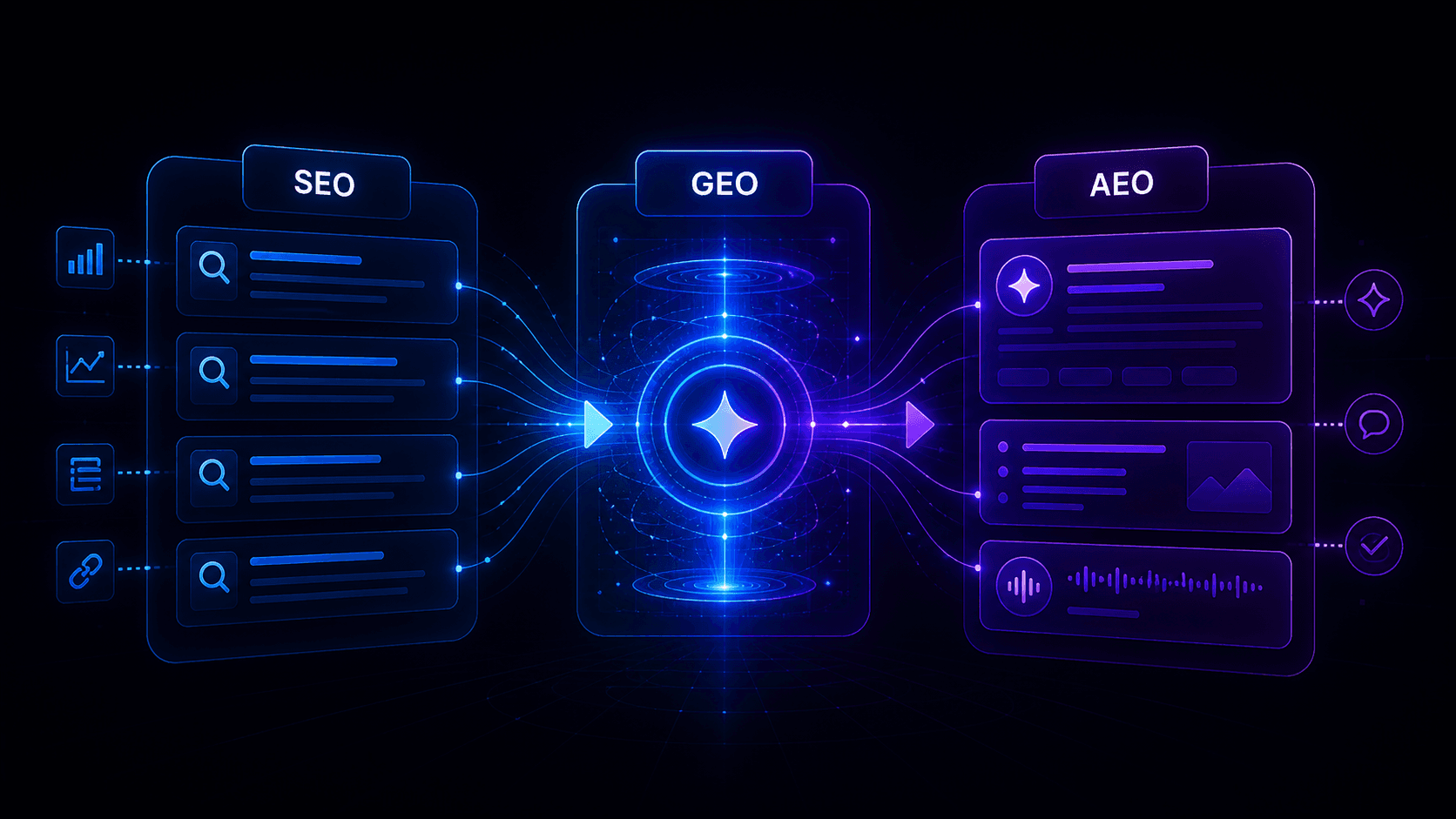
These three concepts are related, but they are not the same.
SEO, or search engine optimization, is the traditional discipline of improving your visibility in search engines. It focuses on rankings, crawlability, site structure, keywords, internal linking, and authority.
AEO, or answer engine optimization, focuses on making your content easy to extract and present as a direct answer. It is about clarity, question-based structure, concise explanations, and content that can be surfaced in snippets or AI summaries.
GEO, or generative engine optimization, is broader. It is about shaping how AI systems understand, describe, cite, and recommend your brand across generative environments. GEO builds on SEO and AEO, but goes further by focusing on AI visibility across prompts, models, and answer formats.
The simplest way to think about it is this:
SEO helps your page get found. AEO helps your answer get extracted. GEO helps your brand get understood and chosen.
Why SEO alone is no longer enough
SEO still matters because AI systems often rely on web content, site structure, and signals of authority. But ranking well in traditional search does not automatically mean you will be visible inside AI answers.
AI models do not simply list pages. They synthesize information. They compare sources. They summarize. They choose what to cite and what to ignore.
That means a page can rank in search and still fail in AI environments if it is vague, overly promotional, badly structured, hidden behind JavaScript, or missing trust signals.
In practice, brands need to optimize for two layers at once:
First, the traditional web layer, where discoverability still depends on technical quality and authority.
Second, the AI answer layer, where visibility depends on extractability, clarity, freshness, and credibility.
What changes in an AI-first discovery model
The move from search to answers changes several things at once.
1. User intent becomes more conversational
People ask AI systems longer, more specific questions. They describe context, constraints, and goals. That means content should no longer be built only around short keyword phrases. It should reflect real questions buyers ask.
2. Structure matters more
AI systems are much more likely to use content that is clearly organized. Strong headings, short paragraphs, direct answers, and logical flow make a big difference.
3. Authority becomes more visible
AI systems are more likely to surface content that appears trustworthy. That includes expert authorship, clear positioning, original insights, supporting evidence, and consistent messaging across the web.
4. Being cited matters as much as being visited
In the traditional model, success was often measured by click-throughs. In the AI model, your brand can influence demand before the click even happens. If AI consistently names your product or company in relevant answers, that visibility has strategic value, even before a user lands on your website.
What good AEO and GEO content looks like
If you want content to perform well in AI environments, it needs to be easier to parse, easier to trust, and easier to reuse.
Here is what that usually looks like.
Start with the answer
Each section should begin with a direct response to the question it addresses. Do not bury the key point deep in the page. Lead with it.
Use question-based headings
Headings should reflect the way real people ask questions. This creates better alignment between user intent and content structure.
Keep paragraphs short
Dense, oversized paragraphs reduce clarity for both readers and AI systems. Shorter blocks are easier to scan, easier to extract, and easier to quote.
Add substance, not fluff
AI systems are more likely to trust content that says something concrete. Strong content includes definitions, distinctions, examples, evidence, tradeoffs, and practical guidance.
Make expertise visible
Do not assume authority is obvious. Show it through author context, first-hand knowledge, original observations, and consistent topical depth.
Keep content fresh
In fast-moving categories, outdated pages lose value quickly. Content should be reviewed and updated regularly, especially when the topic involves AI tools, platforms, behavior, or market changes.
The technical side still matters
Even the best article can underperform if the technical layer is weak.
Your website should make key content accessible in clean HTML. Important information should not depend entirely on heavy client-side rendering or hidden interactive components. Semantic heading structure also matters because it helps both crawlers and AI systems understand the hierarchy of information.
Structured data can also support machine readability. While schema alone will not make content win, it helps clarify what the page is about and how different entities relate to each other.
In other words, strong GEO is not just a writing problem. It is also a content architecture problem.
How brands should adapt their content strategy
Most teams do not need to throw away their content strategy. They need to upgrade it.
A strong modern workflow usually looks like this:
Start by identifying the real questions your audience asks across the funnel. Then map which of those questions matter most for discovery, comparison, trust, and conversion. Next, create content that answers those questions directly and structurally. After that, review whether AI systems are actually surfacing your brand, your pages, and your positioning. Finally, iterate based on what is missing, inaccurate, or underrepresented.
This is where many teams still struggle. They create content, but they do not know how AI systems interpret it, whether competitors are getting cited instead, or which prompts actually matter most.
A platform like Travatar can help close that gap by showing how your brand appears across AI environments, where visibility is missing, and how AI-related traffic interacts with your site. Used properly, that kind of insight turns GEO from a vague concept into an operational workflow.
Common mistakes brands make
A lot of companies are already talking about AI visibility, but many are still optimizing the wrong way.
One common mistake is treating GEO as just another keyword tactic. It is not. AI systems do not reward mechanical repetition the same way older SEO playbooks sometimes did.
Another mistake is creating generic content with no clear point of view. If your content sounds interchangeable, AI has no reason to prefer it.
A third mistake is focusing only on mentions and ignoring quality. Visibility alone is not enough. You also need to know whether AI describes your brand accurately, whether it cites strong sources, and whether the resulting traffic is meaningful.
Finally, many teams still fail to separate human traffic, AI traffic, crawlers, and low-quality automation. That creates distorted analytics and weak decision-making. If your measurement layer is polluted, your optimization layer will be too.
What winning brands will do differently
The brands that perform best in AI-first discovery are likely to do a few things consistently.
They will publish structured, useful, expert-led content. They will make their sites technically readable for machines, not just visually attractive for humans. They will monitor how AI systems describe their category, their competitors, and their own brand. They will update content faster. And they will connect visibility to action instead of treating AI tracking as just another dashboard.
That is the real shift. Winning in AI discovery is not about producing more content. It is about producing better structured content, supported by cleaner signals and sharper feedback loops.
Final takeaway
SEO is still essential, but it is no longer the whole game.
AEO helps your content become easier to extract into answers. GEO helps your brand become easier to understand, trust, and recommend inside generative systems. Together, they create a more complete approach to visibility in the AI era.
If your brand wants to stay competitive, the question is no longer whether AI will shape discovery in your category. It already does.
The real question is whether your content is built for that reality.