Technical AI Readiness: Clean HTML, Schema and llms.txt
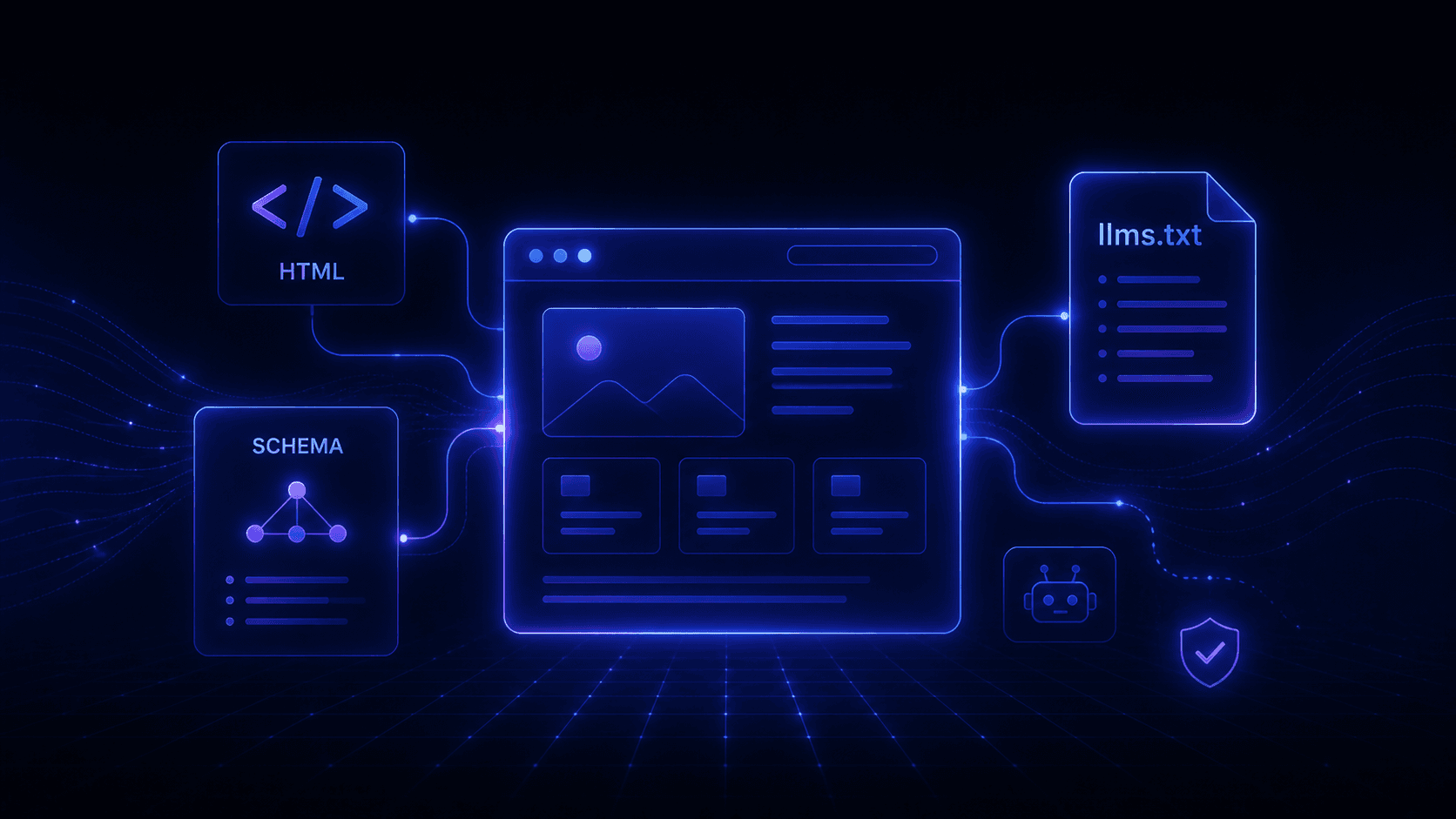
If AI cannot reliably access and interpret your website, it cannot quote it, recommend it, or use it as a trusted source. Technical AI readiness means making your content visible to machines in a clean, structured, and intentional way.
For most teams, that starts with five basics: clean HTML, strong heading hierarchy, useful schema markup, a clear robots.txt policy, and a deliberate llms.txt strategy. Together, these shape whether AI systems can read your site and how confidently they use it.
Why technical AI readiness matters now
A lot of companies still think AI visibility is mainly a content problem. It is not. It is also an infrastructure problem.
Modern AI systems do not experience your website the way a human does. They do not admire your animations, infer your page structure from visual design, or patiently click through hidden interface elements. They look for accessible content, explicit hierarchy, clear signals, and machine-readable context. When those signals are weak, your site becomes harder to parse and easier to ignore.
This is especially important because “AI bots” are not one thing. The No Hacks taxonomy separates at least five distinct categories: training crawlers, search and retrieval crawlers, user-triggered fetchers, opt-out tokens, and undeclared or masquerading traffic. Each category behaves differently, and each requires a different policy decision.
Step 1: Start with clean HTML
The first rule of technical AI readiness is simple: important content must exist in accessible HTML.
If your core message only appears after heavy client-side rendering, interactive loading, or hidden UI states, some AI crawlers may never see it properly. Clean HTML gives crawlers a stable version of the page and reduces ambiguity about what matters most. This is one of the clearest recommendations in current GEO guidance, especially for teams relying heavily on JavaScript-driven websites.
In practice, this means:
- your primary content should be present in the rendered page source,
- key explanations should not depend on tabs, accordions, or scripts to become visible,
- important product, category, and explanatory text should not be buried in dynamic components,
- pages should load with meaningful content even before advanced interface layers activate.
This does not mean every site must become static. It means the parts of the site you want AI to understand should be accessible without friction.
Step 2: Build a heading structure machines can follow
AI systems need structural clues. A clean heading hierarchy is one of the simplest and most overlooked ones.
Your page should have one clear H1 that defines the main topic. H2s should introduce the primary sections. H3s should break those sections into specific subtopics. When this hierarchy is logical, AI systems can identify what the page is about, what each section answers, and which part is most relevant to a user question. OptimizeGEO explicitly highlights semantic headings as a core part of AI readiness.
A few practical rules help:
- Use headings that say exactly what the section is about.
- Prefer clarity over cleverness.
- Make section titles align with real user questions where possible.
- Do not skip levels for visual reasons alone.
- Keep each section focused on one idea.
For AI visibility, heading structure is not formatting polish. It is retrieval infrastructure.
Step 3: Add schema that clarifies context
Schema markup helps machines understand what your content represents, not just what it says.
That matters because AI systems need more than paragraphs. They need context. They need to distinguish between an article and a product page, between a company and an author, between a how-to explanation and a FAQ. Structured data helps define those relationships more explicitly. OptimizeGEO recommends schema for entities, products, FAQs, comparisons, and organizational information because it improves machine readability beyond traditional search use cases.
For most brands, a sensible starting set includes:
- Organization
- WebSite
- Article or BlogPosting
- FAQPage where appropriate
- Product or Service where appropriate
- Person for author context
- BreadcrumbList for content hierarchy
Schema will not compensate for weak content, but it can reduce ambiguity and strengthen the machine-readable layer around strong content.
Step 4: Understand that not all AI crawlers are the same
This is where many teams make bad decisions.
They treat all AI-related traffic as one bucket, then apply one blanket rule. According to No Hacks, that is exactly how websites either over-block and disappear from AI answers, or under-block and feed systems they never intended to allow. The problem is that training crawlers, retrieval crawlers, and user-triggered fetchers serve different functions and should not automatically receive the same treatment.
Here is the practical distinction:
Training crawlers fetch content to help train future models. Search and retrieval crawlers fetch content to support answer generation and indexing. User-triggered fetchers may access content because a real person asked an AI assistant to retrieve it. Opt-out tokens are not crawlers at all. They are policy directives. Undeclared or masquerading traffic is a separate risk category and often requires detection rather than passive rules.
Once you understand that difference, your policy becomes much sharper.
Step 5: Use robots.txt carefully
robots.txt still matters, but it is not a complete AI policy layer.
The No Hacks analysis makes an important point: respect for robots.txt is vendor-dependent, not category-dependent. Some fetchers respect it. Others may not behave the same way. That means a robots.txt file is useful, but not sufficient as your only control mechanism.
You should treat robots.txt as a crawl access policy, not as a full strategic statement.
Use it to answer questions like:
- Which crawlers should access which sections of the site?
- Are there environments, duplicate paths, or low-value pages that should remain blocked?
- Are important content sections accidentally disallowed?
- Are you blocking retrieval access when you only meant to block training access?
That last point is critical. Many teams unintentionally reduce AI visibility by applying overly broad restrictions.
Step 6: Treat llms.txt differently from robots.txt
llms.txt is not a replacement for robots.txt. It serves a different purpose.
robots.txt is a crawler instruction framework with long-established conventions. llms.txt is better understood as a guidance layer for language models and agentic systems. It can help signal which resources matter most, which documents are canonical, and where machine-friendly explanations live. It is not the same as a crawl permission system, and it should not be managed as if it were one.
A good llms.txt approach usually does three things well:
- points AI systems toward the most important, trustworthy pages,
- surfaces canonical explanations of your brand, product, and documentation,
- reduces the chance that fragmented or outdated pages become the dominant machine-readable narrative.
In other words, robots.txt is mostly about access. llms.txt is mostly about guidance.
Step 7: Make your key pages machine-priority pages
Not every page on your site deserves the same level of optimization.
Some pages are strategically far more important for AI visibility than others. These usually include your homepage, product pages, category pages, comparison pages, documentation, FAQ hubs, and foundational thought leadership content. These are the pages most likely to shape how AI systems describe your company.
For those pages, make sure you have:
- a clear primary topic,
- direct introductory copy,
- strong heading hierarchy,
- accessible HTML,
- relevant schema,
- minimal ambiguity,
- updated facts and positioning,
- internal links that reinforce importance.
This is where technical readiness and content strategy meet.
Step 8: Audit what AI systems actually see
A lot of teams assume their site is machine-readable because it looks polished in a browser. That assumption is dangerous.
You need to audit what AI-oriented crawlers and systems can actually access. That means reviewing rendered output, page source, blocked paths, structured data, crawl directives, and which assets contain the real meaning of the page.
A useful workflow includes:
- checking rendered HTML on critical pages,
- reviewing heading hierarchy,
- validating schema markup,
- reviewing robots.txt directives,
- creating or refining llms.txt,
- comparing what humans see versus what machines can easily extract.
This is also where a platform like Travatar becomes valuable. Not because it replaces technical work, but because it helps teams connect technical readiness with actual AI visibility outcomes. When you can see which AI systems access your site, how your brand is interpreted, and where visibility gaps exist, technical cleanup becomes much easier to prioritize.
Common mistakes to avoid
The most common technical AI readiness mistakes are surprisingly simple.
One is relying too heavily on front-end complexity while assuming crawlers will figure it out.
Another is using vague headings that look good in design reviews but communicate very little to machines.
A third is adding schema mechanically without thinking about whether the underlying page is actually clear and trustworthy.
A fourth is treating robots.txt as a universal AI control panel, when it is only one layer of policy.
And one of the biggest mistakes is failing to distinguish between blocking model training and enabling answer visibility. Those are related decisions, but they are not the same decision.
Final takeaway
Technical AI readiness is not glamorous, but it is foundational.
If your content is not accessible in clean HTML, if your heading structure is weak, if your schema is missing, or if your crawl policies are careless, your chances of strong AI visibility drop before content quality even enters the conversation.
The goal is not to optimize for “bots” in the abstract. The goal is to make your most important content easy to access, easy to interpret, and easy to trust across a messy and fast-changing machine ecosystem.
That is the real starting point for GEO.