The AI User Agent Landscape: Understanding Training Crawlers vs User-Triggered Fetchers
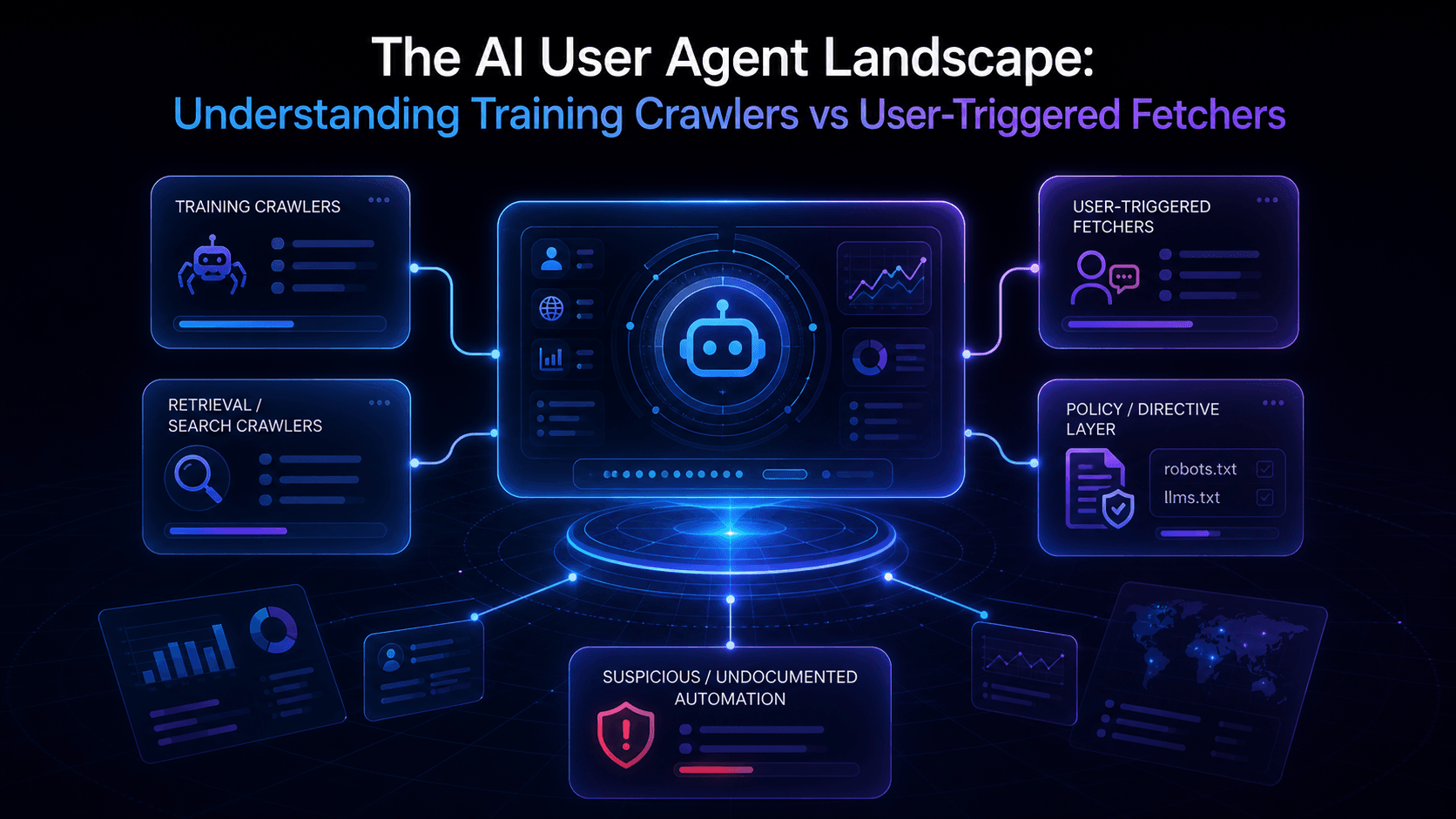
The AI User Agent Landscape: Understanding Training Crawlers vs User-Triggered Fetchers
Short answer
Most websites still treat AI bots as one category, but that is now a serious mistake. In practice, AI user agents fall into several distinct groups, each with a different purpose, risk profile, and policy implication.
If you block them all the same way, you risk either disappearing from AI search surfaces you want to appear in or allowing training access you never intended to grant. The right approach is to distinguish between training crawlers, retrieval crawlers, user-triggered fetchers, opt-out directives, and undocumented or masquerading traffic, then apply clear policies through robots.txt, llms.txt, and your broader traffic monitoring setup.
Why this matters now
A few years ago, most teams could treat crawler management as a relatively simple SEO issue. If a bot was legitimate, you usually let it in. If it looked suspicious, you blocked it.
That model no longer works. AI systems now interact with websites in several different ways. Some bots crawl pages to help train future models. Others index pages so an AI search product can cite them later. Others fetch a page only because a real user just asked a question inside an assistant. Still others operate with weak identification or unclear documentation.
These distinctions matter because the consequences are different. A training crawler affects whether your content contributes to future model behavior. A retrieval crawler affects whether your site appears in answer engines today. A user-triggered fetcher may be tied directly to a real person’s request. Treating all of them as the same bucket leads to bad visibility decisions and weak policy control.
The core mistake: “AI bots” is not one category
One of the biggest misconceptions in AI visibility is the idea that all AI-related bots serve the same function. They do not.
A training crawler collecting data for future models is fundamentally different from a fetcher retrieving a page because someone just asked an assistant to summarize or evaluate it. They may use different user-agent strings, follow different rules, be managed by different vendor teams, and create different consequences for the website owner.
This is why broad, one-line policies are becoming risky. A generic block may protect you from one kind of access while silently cutting off another kind of visibility you actually wanted. On the other hand, a loose allow rule may preserve visibility while opening the door to training pipelines you never explicitly approved.
The five categories of AI user agents
A useful way to think about the landscape is through five functional groups.
1. Training crawlers
Training crawlers fetch content to help train or improve future language models. If you allow them, your content may contribute to future model capabilities. If you block them, you are opting out of that training path.
This is a strategic decision, not just a technical one. Some companies want to support model visibility long term. Others want to preserve more control over how their content is used. The key point is that this decision should be separate from the question of whether you want to appear in AI answers today.
2. Search and retrieval crawlers
Search and retrieval crawlers are visibility infrastructure. Their job is to fetch content so AI systems can build or refresh the indexes used for answer generation and citation.
If you block these crawlers, you may reduce or remove your visibility in AI-powered search and retrieval environments. That is why they should not automatically be grouped with training bots. A company may reasonably want to allow retrieval while still blocking training.
3. User-triggered fetchers
User-triggered fetchers are activated when a real person asks a question and the system needs to retrieve content in response. These are not the same as broad indexing crawlers and not the same as training crawlers either.
Their relevance is growing because more discovery journeys now begin inside assistants rather than in a traditional browser. If your content is accessed this way, the fetch is often directly tied to a live user interaction.
4. Opt-out tokens and directives
This category is often misunderstood because these are not crawlers in the usual sense. They are control directives that influence how existing crawlers or systems should use content.
That matters because some teams incorrectly treat these tokens as if they were separate bots that should appear in logs. They do not. They are policy instructions, not standalone visitors.
5. Undeclared or masquerading traffic
This is the riskiest category. Some traffic behaves like AI scraping or automated extraction but lacks clear documentation, stable identification, or verifiable policy behavior.
This is where passive crawler rules are often not enough. Detection, verification, traffic analysis, and behavioral classification become more important because not every actor in the ecosystem is transparent or well documented.
How to identify different user agents
The first step is simple: stop relying only on broad assumptions and start looking at actual traffic patterns.
In practice, identifying AI user agents usually requires a combination of:
- user-agent string analysis,
- IP verification where available,
- traffic behavior analysis,
- reverse DNS or published range validation when documented,
- comparison between declared bot identity and observed behavior,
- separation of search, training, and user-triggered patterns.
A declared user agent is useful, but it is not always enough. Some vendors publish clear documentation, IP ranges, and bot purposes. Others do not. That means a mature approach combines known identifiers with behavioral validation.
You should also maintain an internal classification model that separates at least these buckets:
- human traffic,
- traditional search crawlers,
- AI training crawlers,
- AI retrieval crawlers,
- user-triggered AI fetchers,
- suspicious or undocumented automation.
Without that separation, your logs become harder to interpret and your policy decisions become less precise.
Why robots.txt still matters
robots.txt still plays an important role, but it is no longer sufficient as a single source of control.
It remains useful for expressing crawler access rules, especially where vendors clearly respect standard directives. For documented user agents, robots.txt can still be the primary policy layer that determines who may access which paths.
But the challenge is that AI traffic is no longer one crawler class with one consistent behavior model. Different vendors handle access differently. Some offer separate controls for training and retrieval. Some publish clean documentation. Some do not. Some user-triggered fetch systems behave differently from systematic index crawlers. That means robots.txt is necessary, but not enough on its own.
How to think about robots.txt rules in practice
A strong robots.txt strategy in the AI era should be more intentional than broad.
Instead of writing one generic policy for “AI bots,” define your rules based on your actual business intent.
For example, ask yourself:
- Do we want to appear in AI search answers?
- Do we want to allow retrieval but block training?
- Are there parts of the site we want visible to citation systems but not included in broader crawling?
- Are there low-value, duplicate, or private areas that should remain blocked regardless of bot type?
- Are we accidentally blocking systems that support visibility while trying to limit model training?
The biggest improvement most teams can make is separating the policy decision for training from the policy decision for retrieval. Those are related, but they are not the same.
Where llms.txt fits in
llms.txt should not be treated as a replacement for robots.txt. It solves a different problem.
robots.txt is primarily about crawler access and path-level rules. llms.txt is better understood as a guidance layer for language models and AI systems. It can help point machines toward the most important resources, clarify what matters on the site, and reduce ambiguity about canonical pages and trusted content.
In practice, llms.txt can support AI readability by:
- highlighting the most important documentation or pages,
- surfacing canonical resources,
- clarifying which materials are meant to represent the brand or product,
- helping AI systems find structured, trusted entry points faster.
That means robots.txt is mostly about permission and restriction, while llms.txt is more about guidance and interpretation.
The right way to use both together
The strongest setup is usually not robots.txt or llms.txt. It is both, with different jobs.
Use robots.txt to define access boundaries for documented crawlers and retrieval systems. Use llms.txt to help AI systems understand which resources matter most once they are allowed in.
A practical model looks like this:
- robots.txt defines who may crawl what,
- llms.txt helps explain what is most important,
- structured data strengthens machine readability,
- log analysis verifies what is actually happening,
- traffic classification confirms whether policy and reality still match.
This layered approach is much more reliable than assuming a single file can solve the whole AI bot problem.
Common mistakes to avoid
There are several predictable mistakes teams make when dealing with AI user agents.
The first is blocking all AI bots with one broad rule. That often sacrifices retrieval visibility when the original goal was only to avoid training.
The second is assuming all user agents that mention AI are equally trustworthy. Some are well documented. Some are not.
The third is believing that opt-out tokens behave like logged crawlers. They do not.
The fourth is relying only on user-agent strings without validating behavior. Some traffic may identify poorly or inconsistently.
The fifth is managing bot policy without connecting it to real visibility outcomes. If your crawler rules change but you are not monitoring what happens to AI citations, prompt visibility, or downstream traffic, you are making policy decisions without feedback.
Why this matters for AI visibility strategy
Bot classification is not just an infrastructure detail. It directly affects your visibility strategy.
If you want to show up in AI-generated answers, you need to know which systems support retrieval and which ones are involved in training. If you want cleaner analytics, you need to distinguish humans from AI fetchers and broader automation. If you want to protect content use while preserving answer visibility, you need a more precise policy than “allow all” or “block all.”
This is also where a platform like Travatar becomes strategically useful. It helps teams move beyond static policy files and understand what is actually happening on the site: who is visiting, how AI systems interact with content, what belongs to retrieval versus training, and where the signal is getting distorted by automation.
That kind of visibility is important because crawler policy without signal intelligence is still guesswork.
Final takeaway
The AI user-agent landscape is now too complex to manage with old assumptions.
Training crawlers, retrieval crawlers, user-triggered fetchers, opt-out directives, and undocumented traffic all play different roles. Treating them as a single group leads to bad decisions, weaker visibility control, and less reliable analytics.
The winning approach is more deliberate. Classify AI traffic more precisely. Use robots.txt for access control. Use llms.txt for machine guidance. Monitor what actually happens in logs and on-site behavior. And make visibility decisions based on the specific function of each visitor, not on the outdated idea that every AI bot is the same.