AI Traffic Explosion: What 7,851% Growth Means for Cybersecurity
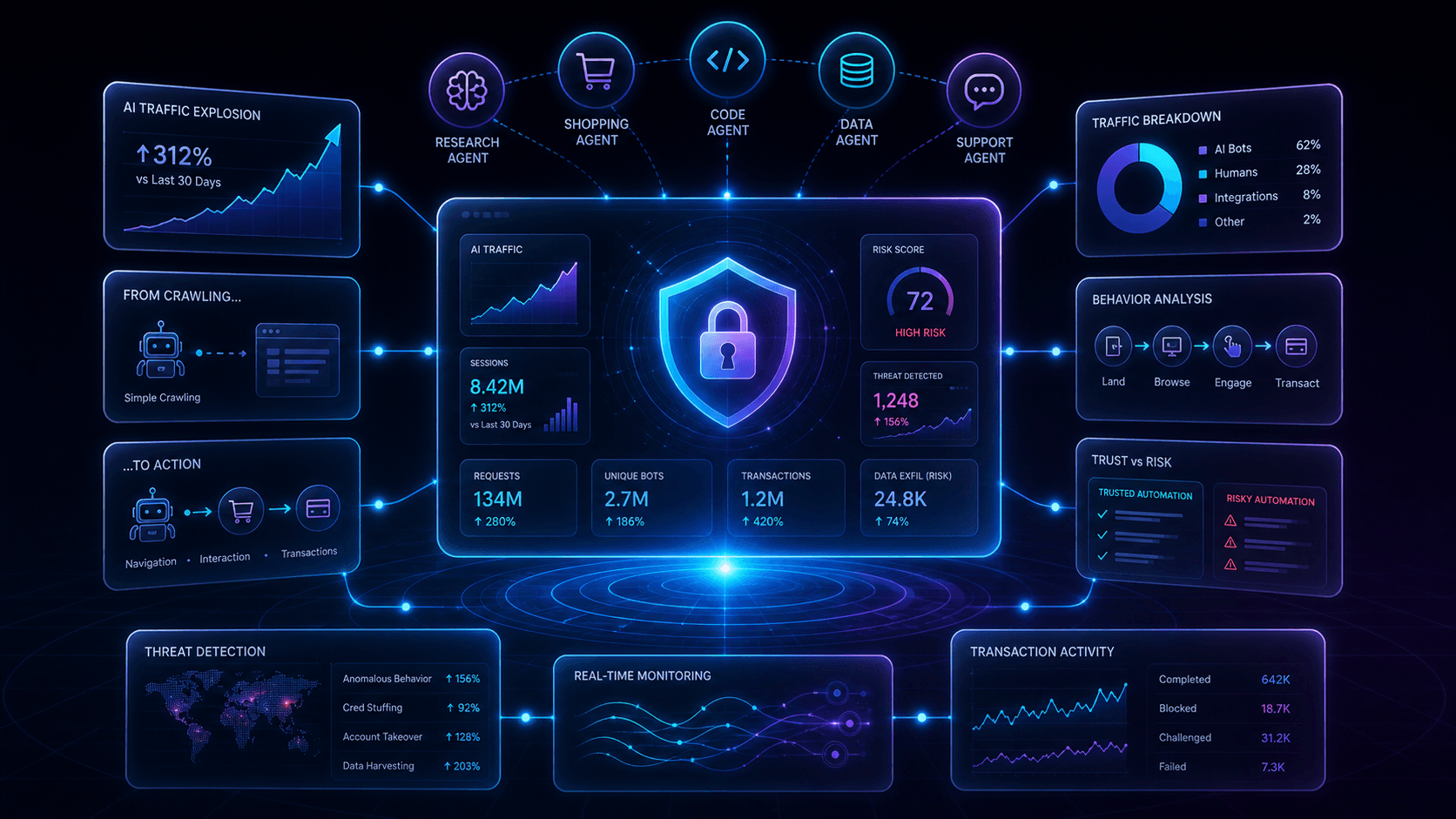
AI Traffic Explosion: What 7,851% Growth Means for Cybersecurity
Short answer
AI traffic is no longer a niche technical phenomenon. It is becoming a major operational and security reality for websites, apps, and digital commerce. The biggest shift is not just volume, but behavior.
When AI agents move from reading content to completing actions such as navigation, account interaction, and checkout flows, the line between helpful automation and malicious automation becomes much harder to draw. That is why cybersecurity teams now need a different framework for identifying intent, not just detecting bot-like behavior.
Why this matters now
For years, most organizations treated automated traffic as a mostly defensive problem. Bots were usually associated with scraping, fraud, abuse, credential attacks, or invalid traffic. Human activity and malicious automation looked different enough that the separation was often manageable.
That distinction is becoming weaker. New AI agents can behave much more like real users. They can browse pages, compare products, complete sequences of actions, and in some cases even move into transactional flows. As AI systems become more capable, the old assumption that “automated equals suspicious” stops being useful on its own.
This changes the security model. Teams can no longer rely only on crude automation signals. They need to evaluate whether the activity is legitimate, whether it is acting on behalf of a user, and whether the same behavior could also be exploited by a malicious actor.
The shift from crawling to acting
The most important change in AI traffic is that automated systems are no longer limited to passive observation.
Traditional crawlers mostly read, indexed, or scraped. They moved through the web as collectors of information. AI agents are different. They can interact. They can move through workflows. They can make decisions within those workflows. In some environments, they can even participate in actions that were once clearly human-controlled.
That means websites are no longer facing only “machine readers.” They are increasingly facing machine actors.
This is a much bigger cybersecurity issue because acting systems affect the same parts of the digital journey that are already sensitive: login flows, account actions, shopping experiences, payment paths, and user state transitions. Once automation reaches those layers, the consequences become operational, financial, and trust-related.
Why the 7,851% figure is so important
A number like 7,851% is not just a traffic story. It is a signal that the environment has changed faster than most teams’ control models.
A sharp rise in agentic activity means the threat model is evolving at the same time as the growth model. AI traffic is becoming more commercially relevant, but also more difficult to classify. A system that lands on a checkout page could be part of a useful shopping assistant experience, or part of a fraud workflow. The visible behavior may look very similar. The intent may be completely different.
This is what makes the current moment difficult. Growth in AI traffic is not automatically good or bad. It is ambiguous. And ambiguity is exactly what makes security harder.
The collapsing line between legitimate and malicious automation
This is the core issue.
Many of the signals that once looked suspicious now also appear in legitimate AI behavior. Rapid navigation, repetitive structured actions, automated form handling, and machine-speed interaction were once strong indicators of abuse. But modern AI agents can generate those same patterns while performing useful work for a real user.
That means the challenge is no longer simply detecting automation. The challenge is distinguishing between beneficial automation and harmful automation.
This is a fundamental shift. In the old model, unusual speed or structured behavior often justified defensive action. In the new model, the same signals may represent a valid AI-mediated customer journey. Blocking everything aggressive or non-human can now damage future-ready user experiences. Allowing everything automated can expose the business to fraud, scraping, or account abuse.
Cybersecurity now has to operate inside that gray zone.
Why intent matters more than ever
As AI traffic grows, intent becomes more important than raw detection.
A browsing pattern on its own is not enough. A click path on its own is not enough. Even account interaction is not enough. Security teams need stronger context around who initiated the action, what the automation is trying to achieve, whether the system is trusted, and whether the behavior aligns with an allowed use case.
This is why AI-era bot management is moving beyond binary classification. “Human” versus “bot” is no longer enough. Teams need categories such as:
- human traffic,
- traditional crawlers,
- AI retrieval systems,
- AI agents acting on behalf of users,
- suspicious automation,
- confirmed malicious abuse.
Without those distinctions, decision-making becomes blunt. And blunt controls create two types of damage: security gaps on one side and blocked legitimate demand on the other.
The biggest cybersecurity implications
1. Checkout and commerce flows become more exposed
Once AI agents begin reaching product, cart, and checkout environments, the commercial layer becomes part of the AI security story.
That matters because transaction flows are already high-risk surfaces. If AI agents can operate inside them, then fraud actors can also try to weaponize similar behaviors. The same architectural shift that enables agentic commerce can also expand the attack surface for carding, abuse, and automated purchase manipulation.
2. Account environments become harder to defend
When AI systems begin interacting with authenticated workflows, security teams can no longer assume that complex session behavior is human by default. An AI agent managing a legitimate user task may look structurally similar to a system attempting account misuse.
That makes post-login monitoring much more important. Authentication is not the end of trust evaluation anymore. It is only one step.
3. Scraping and data extraction become harder to classify
Older scraping activity often looked easier to spot. Today, extraction can be wrapped inside more human-like, adaptive, agentic behavior. That does not reduce the risk. It increases the difficulty of identifying it correctly.
4. Trust becomes a traffic layer
The question is no longer just whether a visitor is human. The question is whether the automation is trusted, accountable, and operating within acceptable boundaries.
That means security teams need a trust layer for AI-driven traffic, not just a bot filter.
What this means for bot detection strategy
The old strategy of blocking anything that behaves like automation is becoming obsolete.
A stronger modern strategy usually includes:
- classification of different bot and agent types,
- behavioral analysis instead of user-agent reliance alone,
- verification of whether automation is tied to legitimate user intent,
- separate handling for crawlers, agents, and suspicious systems,
- visibility into where AI activity appears across the site,
- policy controls that adapt by workflow sensitivity.
This is not just more complex security. It is more precise security.
The winning approach is not maximum blocking. It is controlled access with better interpretation.
Why analytics and security now overlap
One of the reasons this shift is difficult is that security and measurement are starting to overlap.
If a company cannot distinguish between human traffic, AI agent traffic, retrieval bots, and malicious automation, then both its analytics and its defenses become weaker. Security teams may overreact to good automation or miss harmful patterns. Growth teams may celebrate traffic that has little commercial value. Product teams may misread user behavior because the signal is polluted.
This is exactly why AI traffic cannot be treated as just another analytics curiosity. It affects attribution, trust, conversion interpretation, fraud risk, and system design at the same time.
What companies should do now
The most practical next step is not to panic about AI agents. It is to improve visibility and classification.
Start by identifying where AI-related traffic already appears in your environment. Then separate retrieval traffic from agentic activity where possible. Review whether sensitive flows such as login, checkout, and account actions are being touched by automated systems. Evaluate whether your current bot controls are too broad, too weak, or too dependent on outdated signals.
Most importantly, stop asking only “is this a bot?” and start asking “what kind of automation is this, what is it doing, and should it be allowed here?”
That question is much more useful in 2026.
Where a broader signal layer helps
This is where a platform like Travatar becomes strategically useful.
Security tools can tell you part of the story, but Travatar helps connect AI traffic, crawler behavior, traffic quality, and website interaction into a broader signal layer. That matters because organizations do not just need more blocking. They need better interpretation.
When you can distinguish between human visitors, AI crawlers, AI agents, and suspicious automation, you make better decisions across cybersecurity, analytics, product, and visibility. In a web environment where the same behavior can be either useful or dangerous, that clarity becomes a real advantage.
Final takeaway
The explosion in AI traffic is not just a trend. It is a structural shift in how the web works.
A 7,851% rise in AI agent activity signals a new phase where automated systems are no longer just reading the web. They are acting inside it. That creates opportunity, but it also creates ambiguity. And ambiguity is exactly what raises cybersecurity stakes.
The organizations that respond best will not be the ones that simply block more automation. They will be the ones that classify it better, understand intent more clearly, and build smarter trust controls for the agentic web.