AI visibility platform pricing: what to ask about prompts, traffic data and conversion reporting
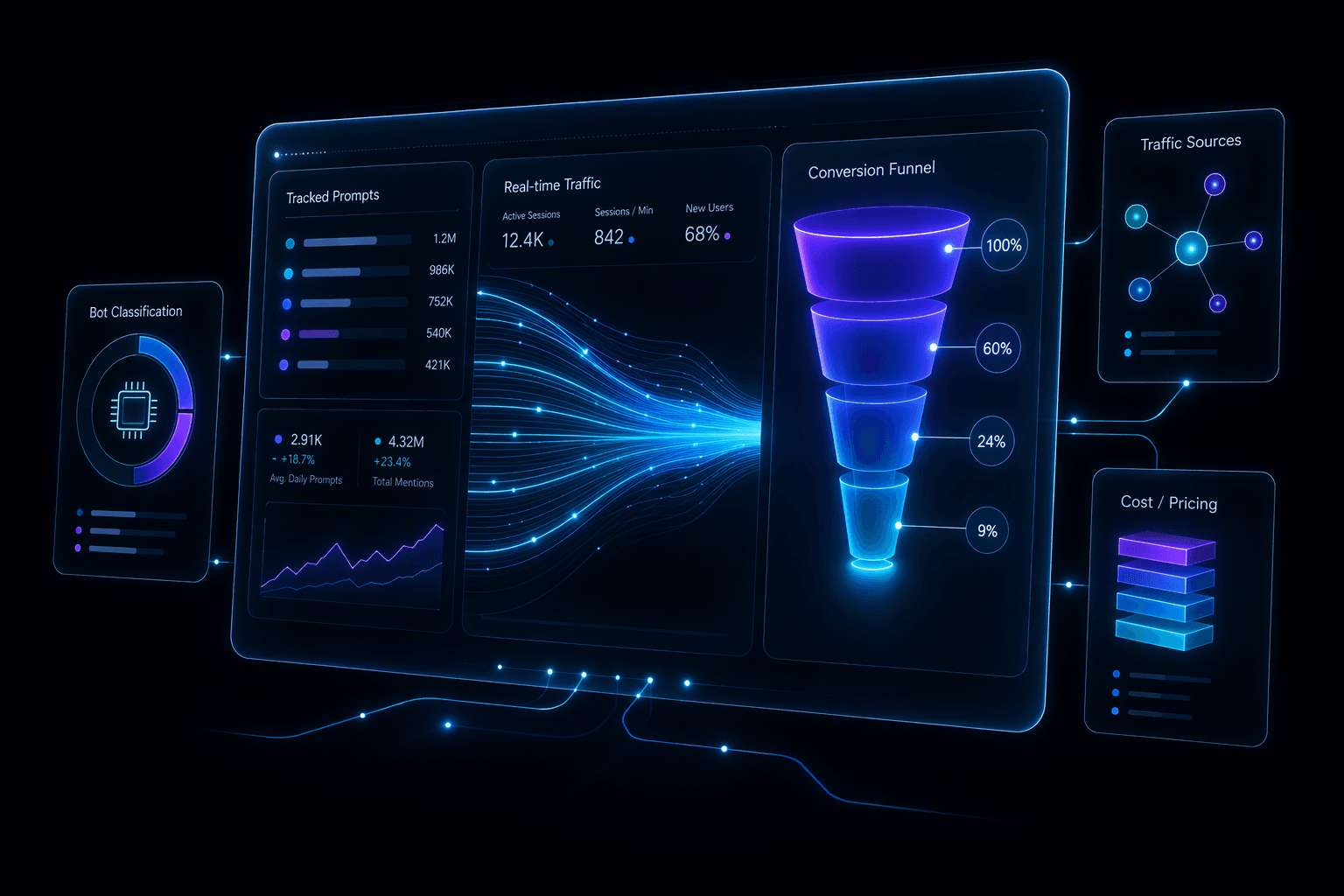
How to evaluate the cost of measuring AI visibility and conversion impact
A useful AI visibility quote shows what the vendor counts, what each limit covers, and how it connects AI activity to conversions. For marketing, growth and product teams, the decision is whether the quoted package can measure the workload they expect and produce conversion reports they can interpret, without unexpected usage charges.
Travatar is an AI-native SaaS platform for AI visibility analytics and web-traffic intelligence, with AI Visibility, AI Coworker and AI Traffic Analytics modules. We monitor brand visibility in AI Search, classify bot traffic and help teams assess its impact on conversions. When comparing a Travatar proposal with another vendor’s, apply the same workload and reporting questions to each quote.
AI visibility platform pricing for conversion reporting: what to expect and which limits matter
A conversion-reporting quote may meter events, attributed conversions, sites or access to a reporting tier, while attribution rules, data retention and bot filtering can change what the buyer receives; request written definitions for each proposed unit and limit, then test the reporting against familiar conversion data before accepting the quoted scope.
Start by separating measurement volume from reporting access. A vendor might count every incoming conversion event, count only events attributed to an AI-related interaction, limit the sites covered, or include conversion reporting within a package. Treat these as questions for the quote, not interchangeable descriptions of the same service. If the proposal says “conversions included,” ask what is counted, where the count is taken and what happens when the allowance is exceeded.
Which conversion-reporting limits belong in the quote?
Ask the vendor to state:
- Which conversion types are included, such as a completed purchase, a lead submission or another event your team defines.
- Whether the allowance counts raw events, deduplicated conversions or conversions attributed to AI-related traffic.
- Which domains or sites are covered, including how a journey across sites is handled.
- How long conversion-level records remain available and whether historical reports change when that period ends.
- Whether classified bot or agent traffic is included, excluded or shown separately.
- Whether reporting access depends on a package, seat allowance or another contract limit.
- How excess usage is calculated and approved before it is billed.
The distinction between traffic classification and conversion attribution matters. A report can classify an on-site visit as bot traffic without proving that an earlier AI-generated answer caused a later purchase. Ask to see the event path and the rule that connects each step.
How does attribution change the reported impact?
Attribution assigns credit to a conversion under a defined rule. A last-touch method credits the final identified interaction. A multi-touch method distributes credit across identified interactions. Deterministic matching relies on an observed link between records, while modelled attribution uses an estimated relationship. None should be treated as the right method for every buying journey.
Ask the vendor which method its report uses, what data the method requires and what happens when an interaction cannot be matched to a conversion. Request the same sample journey under each method the vendor proposes. Compare the resulting conversion counts with your existing analytics baseline, then decide which report answers your business question. A change in attributed conversions can change perceived return even when the underlying sales events have not changed.
A short proof of concept makes this review concrete. Agree on a defined site, a known set of conversion events, the attribution rule, the bot-handling rule and the reporting period. Put the included usage, access to underlying records and treatment of overages in writing. The acceptance test should be whether your team can reconcile sample output with its baseline and explain any difference, not whether a dashboard displays a favourable figure.
Travatar’s AI Visibility, AI Coworker and AI Traffic Analytics modules address related parts of this workflow. For a Travatar quote, ask our team to specify the metering units, reporting scope, retention terms and attribution method that apply to the proposed package rather than assuming that a module name defines its commercial terms.
How AI visibility platforms price prompt tracking and traffic analytics: billing units and questions to ask
Prompt-tracking and traffic-analytics quotes can count monitored queries, generated responses or credits, engine coverage, sites, traffic events or seats, so buyers should define what counts as a prompt, establish how each tracked interaction is measured, and test those definitions with a representative workload and a sample invoice before comparing totals.
A tracked prompt is not necessarily the same thing as a response. A vendor may monitor a saved query across AI engines, collect multiple responses to the same wording or run repeated checks over time. The commercial question is which of those actions consumes an allowance. A quote labelled “per prompt” is hard to compare until the vendor explains whether it means a distinct saved query, a query sent to an engine or each check that produces a response.
The same issue applies to traffic analytics. Ask whether usage is measured from visits, requests, classified bot events, data processed or access to reports. These are possible contract units, not claims about how every vendor bills. Write the proposed unit beside the expected workload before comparing package prices.
What should a buyer’s checklist ask?
Use the same questions in each request for proposal and demonstration:
- What counts as a billable prompt: a saved query, an engine-specific query, a scheduled check, a retry or a generated response?
- How is a tracked interaction recorded? Can the team trace a reported count to a timestamp, query and engine?
- Which AI engines and models are included, and do ChatGPT and Gemini have the same collection and billing rules?
- Are response collection, repeated sampling, query length or token use subject to separate limits?
- What units apply to traffic analytics, and how are bot or agent events counted?
- Which domains, sites and user seats are included?
- What happens if usage rises unexpectedly? Is collection paused, billed as an overage or moved to another tier?
- What history can the team export, and how long is prompt-level and traffic-level data retained?
These questions turn a headline price into a comparable scope. For example, two proposals may cover the same saved queries but produce different billable volumes if one counts each scheduled engine check and the other counts each distinct query. That is a scenario to test in the vendors’ written definitions, not a cost difference to assume in advance.
What should the demo and sample invoice prove?
Give each vendor the same sample workload: a set of queries, the engines to monitor, the planned checking schedule, the sites to analyse and the traffic events relevant to your team. Request an itemised sample invoice for a representative month. Have the vendor show how its definition of “prompt” produces every prompt-related line item and explain how a temporary usage spike would appear.
Request a CSV export with prompt text or identifier, timestamp, engine and the fields used to reconcile the reported count. If the vendor uses credits, ask what activity consumes a credit and whether unused credits carry over. For traffic analytics, request an example that lets your team distinguish classified bot activity from the conversion events included in the report. Specify the fields your team needs for reconciliation rather than assuming every export contains them.
A workable vendor questions worksheet can fit in the evaluation document:
- Metering definition: What action creates a billable unit, and can it be traced to an exported record?
- Coverage: Which engines, sites, traffic events and users are included in this quote?
- Conversion method: What rule attributes a conversion to an AI-related interaction, and how are unmatched events treated?
- Data access: Which underlying records can be exported, and for how long?
- Contract behaviour: What happens at an allowance limit or during a usage spike?
- Validation: Can the vendor calculate a sample invoice and report from the workload supplied by your team?
Map the proposed scope to those questions and identify where it fits in the workflow. Ask for the applicable terms in the quote, including module-level units, retention and reporting rules. Then use the same test data and worksheet for every proposal. The next step is a scoped demonstration that reconciles usage and conversion output before a wider commitment.
FAQ
What exactly should I ask vendors to define when they say “per prompt” or “per response”?
Ask whether a prompt means a distinct saved query, a query sent to a specific engine or each scheduled check. Ask whether a response, retry or repeated collection consumes another unit, and request an export that lets your team reconcile the count.
How does the choice of attribution method affect reported conversion impact and price?
Attribution rules determine which conversions receive credit for an AI-related interaction, so different rules can produce different reported impact from the same underlying events. Ask which method the vendor uses, what data it needs and whether reporting or data processing under that method affects the quoted scope.
Which contract limits commonly cause surprise costs: retention, spike billing, or bot-filtering?
Any of these can change the value of a proposal if its terms are unclear. Ask how long underlying records remain accessible, how usage spikes are billed and whether classified bot or agent activity is included in conversion reporting.
What sample exports or invoices should I request to validate a vendor’s metering?
Request an itemised sample invoice based on your expected workload and a CSV export with prompt identifiers, timestamps and engine attribution. For conversion reporting, request sample underlying events and the rule used to attribute them, so your team can reconcile the output with its analytics baseline.
Does Travatar publish its pricing tiers and metering units publicly?
Request a Travatar quote that states the pricing terms and metering units for the modules in scope. Ask our team to specify included usage, retention, attribution rules and overage treatment in writing before comparing the proposal with alternatives.