From Public Relations to Prompt Relations: The New Role of Earned Media
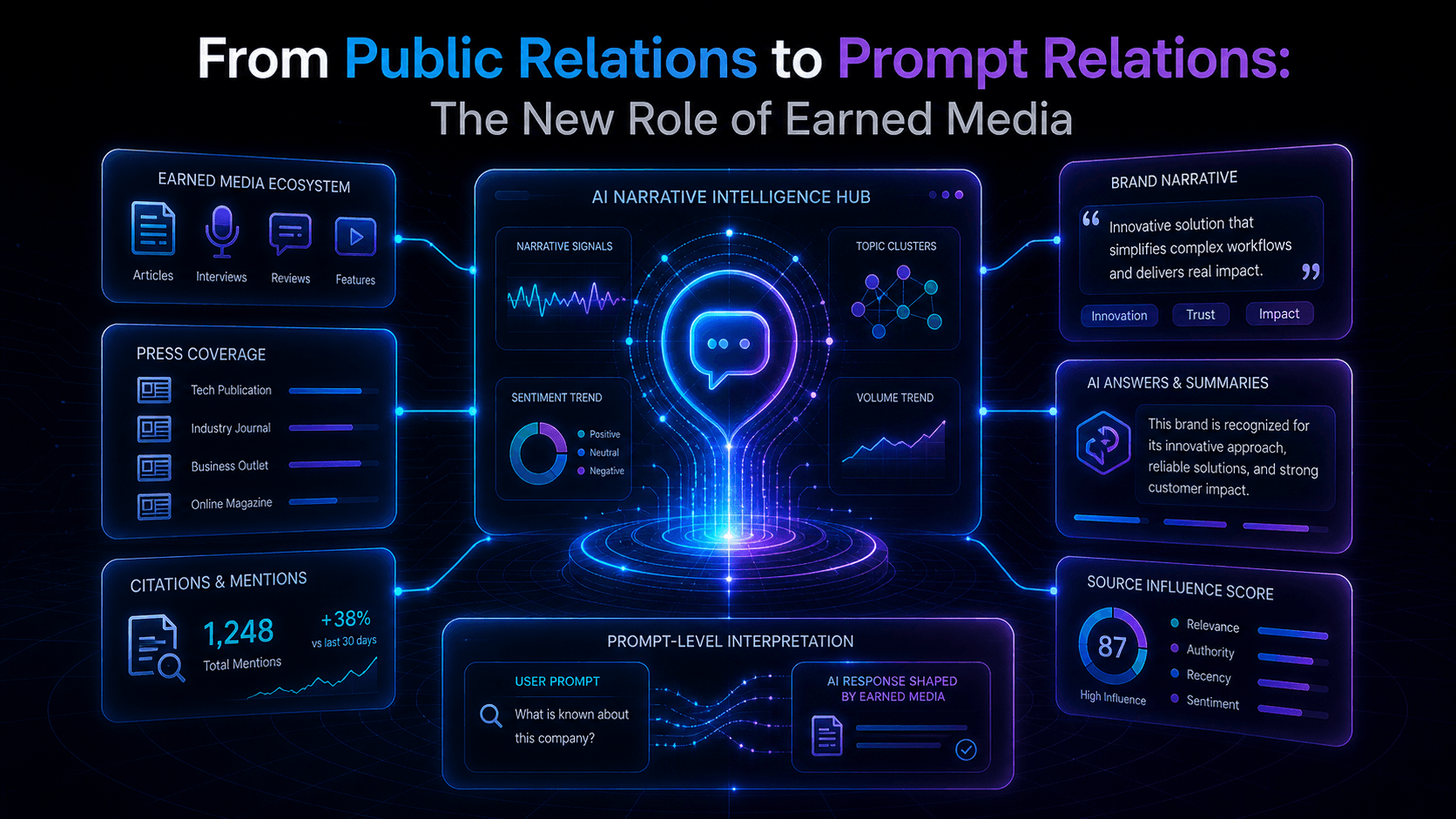
From Public Relations to Prompt Relations: The New Role of Earned Media
Short answer
Public relations is no longer just a media function. In the AI era, it is becoming a narrative infrastructure layer. As AI systems increasingly shape how buyers discover, compare, and evaluate companies, earned media helps determine what those systems learn, trust, and repeat about a brand.
That is why earned media now matters far beyond visibility in traditional publications. It affects whether your company is cited, how your category position is framed, and whether your brand narrative is reinforced or diluted in AI-generated answers.
Why this matters now
For years, PR and SEO often worked in parallel. PR focused on coverage, reputation, and media relationships. SEO focused on search rankings, on-site content, and technical visibility. In the AI era, those two worlds are converging. AI systems rely heavily on authoritative third-party sources, structured brand narratives, and repeated patterns of external validation. That means earned media is becoming one of the strongest inputs into how machines understand a brand.
This is why PR is no longer judged only by coverage volume or sentiment. It is becoming directly tied to AI visibility and, by extension, to demand generation and revenue outcomes.
The shift from media relations to prompt relations
The old PR model assumed that if you shaped the media narrative, you shaped public perception. That still matters, but there is now an additional layer between publication and audience: the AI system.
A journalist, analyst, reviewer, or trade publication may publish a story today, but a buyer may encounter that story later only through an AI-generated summary. In other words, media coverage is no longer just read directly. It is also ingested, interpreted, compressed, and reused. That creates a new discipline that can be described as prompt relations: shaping the external information environment so that when AI systems are asked about your company, they return a stronger and more accurate answer.
This does not replace PR. It expands it. The communications function still builds relationships, creates narratives, and earns trust. What changes is the downstream consumer of that work. It is no longer only the human reader. It is also the AI layer mediating discovery.
Why earned media matters more in AI than many marketers expect
Owned content is still important, but AI systems often place significant weight on credible third-party validation. That gives earned media a strategic advantage. Third-party coverage can act as corroboration. It helps answer the implicit machine-level question: is this brand important enough, trustworthy enough, and established enough to cite?
This is one reason the old distinction between PR and performance marketing is breaking down. In the AI era, a strong article in the right publication can do more than create awareness. It can strengthen the brand’s external knowledge footprint. Over time, that footprint influences how AI systems summarize the category, which vendors they mention, and how they frame the tradeoffs between alternatives.
Why PR is becoming a GEO and AEO growth lever
The most important shift is that PR is no longer only upstream reputation work. It is becoming part of the commercial visibility stack.
If AI systems increasingly act as intermediaries between brand and buyer, then the sources they trust become strategically important. And PR is one of the main disciplines that shapes those sources. This is why earned media is becoming a growth lever in GEO and AEO. It helps influence how brands are understood before a user ever clicks on a website.
The brands that benefit most from this shift will be the ones that actively shape their AI narrative. Over time, that creates a compounding advantage. When a company is repeatedly described in consistent, high-trust ways across earned sources, AI systems are more likely to reinforce that framing.
What PR teams need to do differently
1. Stop measuring PR only by impressions and backlinks
Traditional PR reporting is no longer enough. Impressions, placements, and backlinks still matter, but they do not fully explain how a brand is represented in AI-generated answers.
Teams should begin asking additional questions. Which publications are most likely to influence AI descriptions? Which narratives are being repeated? Which earned mentions show up in category comparisons? Which brand messages survive when an AI system compresses the story into a short answer?
This is how PR starts to connect with AI visibility in a measurable way.
2. Treat press releases and newsroom content as machine-readable narrative assets
In the old model, a press release often existed mainly to support media pickup. In the AI era, it can also function as a canonical source of truth for machines.
Communications teams should think more carefully about clarity, structure, consistency, and entity-level precision in releases and newsroom pages. This means those materials should not be vague, bloated, or overloaded with generic claims. They should clearly explain who the company is, what it does, how it is differentiated, and what category language the brand wants associated with itself.
If AI systems ingest those materials, ambiguity becomes expensive.
3. Prioritize authority-rich third-party coverage
Not every mention is equally useful. Coverage in respected trade outlets, industry publications, and trusted expert environments often carries disproportionate narrative weight.
That means PR teams should optimize not only for reach, but also for authority, relevance, and topical alignment. A smaller number of high-trust mentions can be more valuable than a larger number of shallow placements if the real goal is to influence AI-generated summaries.
4. Coordinate PR, content, and SEO much more tightly
PR can no longer operate as an isolated communications stream. The strongest results come when PR, content, and search teams reinforce each other.
If the earned narrative says one thing, the website says another, and the product pages use different language again, AI systems inherit that inconsistency. But when press coverage, owned thought leadership, product messaging, and technical content all reinforce the same positioning, the brand becomes easier for AI systems to understand and repeat.
This is one of the biggest structural changes in modern digital strategy. PR, content, and visibility work are no longer separate layers. They are increasingly part of one narrative system.
The new job of agencies
The agency role is changing too.
In the older model, agencies often pitched stories, managed media relationships, and measured outputs through coverage and sentiment. In the emerging model, agencies will increasingly be expected to shape machine-readable brand authority.
That means they will help clients influence not only what gets published, but also what gets repeated by AI systems. This creates a higher bar. Agencies will need stronger analytical fluency, better understanding of AI visibility, and more discipline around message consistency, source quality, and digital footprint design.
The future PR partner is not only a storyteller. It is also a narrative systems operator.
Common mistakes brands make
One common mistake is assuming that strong owned content alone will determine AI visibility. In reality, many AI systems use third-party corroboration as part of their trust model.
Another mistake is treating PR as awareness work while leaving AI narrative formation unmanaged. That creates a gap where the brand may be widely discussed, but not clearly understood.
A third mistake is focusing on short-term coverage volume rather than on whether the right sources are reinforcing the right message.
And one of the biggest mistakes is failing to connect PR outcomes with AI visibility measurement. If you do not know how AI systems describe your brand after a campaign, then you do not yet know the full value of the campaign.
Why this matters for Travatar’s worldview
This shift fits naturally with Travatar’s broader perspective on the web. If the future of digital growth depends on stronger signal, cleaner interpretation, and better decision-making, then earned media becomes part of the signal layer, not just a separate awareness channel.
That is why PR now matters not only for reputation, but also for how brands are represented inside AI systems. A platform like Travatar helps make that visible by connecting AI mentions, traffic quality, source influence, and broader machine behavior. In practice, that helps teams understand whether external narrative work is actually shaping the AI-facing reality around the brand.
Final takeaway
Public relations is entering a new phase. In the AI era, it is no longer only about getting coverage. It is about shaping the external information environment that AI systems learn from, cite, and compress into answers.
That is why the move from public relations to prompt relations is more than a catchy phrase. It captures a real structural shift. Earned media is becoming one of the most important levers for influencing how brands are described in AI discovery.
The companies that understand this early will not just earn more coverage. They will build stronger AI narrative control.