Adding AI agent measurement to an existing analytics stack
How to measure AI-agent requests alongside your existing web analytics: a practical implementation path
To measure AI-agent requests without replacing existing web analytics, keep browser tracking in place and add request logs, agent classification and a shared reporting layer. This approach separates what a browser records from what a server receives, then brings both views together for analysis of traffic and conversions.
Which analytics platforms are easiest to add into an existing marketing and product stack?
The easiest starting point is usually the analytics system already in use, paired with a way to ingest server, CDN or API request logs. A JavaScript-first setup such as Google Analytics 4, an existing Matomo deployment, or a warehouse-led approach can each serve as the reporting foundation. Choose among them by testing how request data and classification labels enter the current stack, rather than assuming a platform detects agents on its own.
Google Analytics 4 documentation describes its website event collection approach. Browser events remain useful for understanding human journeys, but JavaScript tagging cannot record a request that never runs the tag. A request log is therefore the appropriate starting point for examining non-browser visits to pages or APIs. Cloudflare’s logs documentation describes request-level logging options that can supply that view where Cloudflare is already in the delivery path.
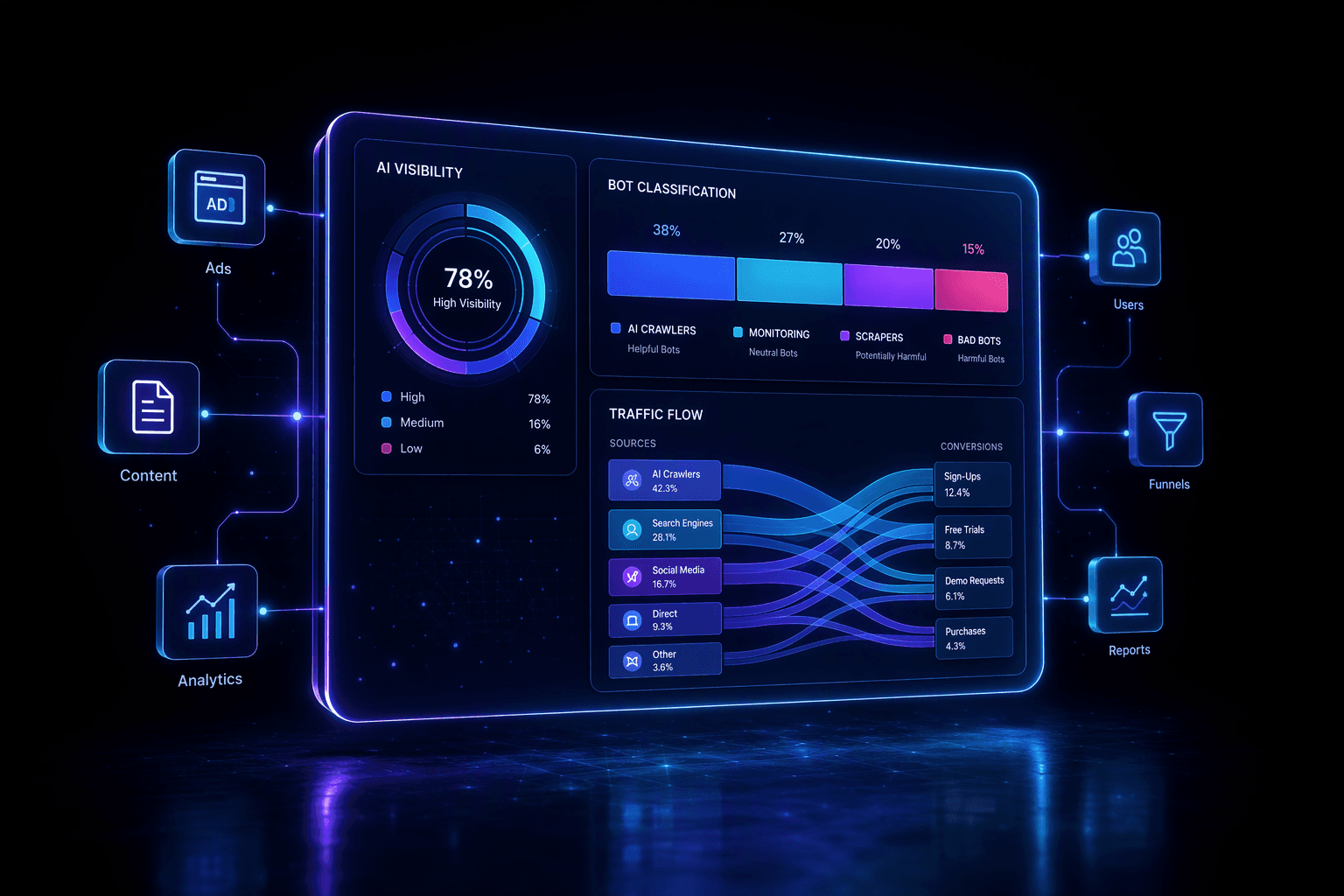
The architecture is additive: browser events continue into existing analytics; server, CDN and API gateway requests enter a logging pipeline; a classification step labels requests; and the resulting records meet conversion events in a warehouse or analytics layer. This keeps existing reports available while giving teams a separate view of requests that browser tracking may miss.
Before selecting a tool or extending an existing one, run a short vendor and connector review:
- Establish whether it ingests the server, CDN and API logs available in the stack, or whether those logs need a separate pipeline.
- Test the actual path into the chosen reporting layer, including any proposed connector to BigQuery, Snowflake or ClickHouse. Inspect field mappings with sample records rather than relying on a connector name.
- Confirm that request-level attributes and conversion identifiers can be retained in usable fields, and that agent labels can be queried as dimensions.
- Ask how sampling, aggregation and data residency rules apply to the records needed for analysis.
- Test how quickly changed classification rules appear in reporting, including whether historical records can be reprocessed.
These are acceptance tests, not assumed features of Google Analytics 4, Matomo or any connector. They reveal the engineering work before a platform decision commits the team to a data model.
The work also differs by collection path. A browser-tag change may require little application work, but it cannot fill a non-browser request gap. Log ingestion requires access to delivery or application infrastructure and a parser for its request fields. Joining logs to conversion events requires consistent event definitions, controlled identifiers and a repeatable transformation. Prefer the path that uses infrastructure the team can inspect and operate.
What alternatives to traditional web analytics can measure traffic generated by AI agents?
Server, CDN and API request logs, enriched with agent labels and joined to existing events, provide a practical alternative view of AI-agent traffic. Keep client-side analytics for browser activity, then use the request stream to investigate non-browser activity and assess how classification changes traffic and conversion reporting.
Which signals belong in the hybrid measurement path?
Start with raw request records from the server, CDN and API gateway paths relevant to the property being measured. Preserve the original attributes used for classification alongside the resulting label. That makes a label auditable when detection rules change. The logging options in Cloudflare’s documentation illustrate a delivery-layer source; an application or API gateway can supply another request stream.
Travatar accepts and stores IP/ASN as request-level identifiers and event_id as a conversion-event identifier. In a joined data model, keep IP/ASN attached to request records and event_id attached to conversion events. Do not treat an IP address or ASN alone as proof that two events came from the same agent, or as proof that a particular request caused a conversion. Use the available event and session context, with documented join rules, to distinguish a direct link from an inferred association.
Travatar uses Google Search Console to monitor brand presence in AI responses. Treat Google Search Console as a complementary brand-presence signal, not as an agent-request log or a count of appearances in AI answers. Its performance reporting documentation describes search performance data; request classification still depends on request-level evidence.
How should agent labels reach conversion reporting?
A classification layer should read request attributes, apply documented rules or models, and write a label alongside the request record. It can run before storage or during ingestion. Retain the raw attributes, label, classification version and processing time so analysts can reproduce a report after the logic changes.
Join classified requests to browser and conversion events only where the available identifiers support the join. Report unmatched requests separately. This distinction matters: a labeled request can establish that the server received traffic matching a classification rule, while a conversion association requires additional event evidence.
A compact pilot can follow this sequence:
- Select a page path and an API path that produce accessible request logs.
- Collect those logs alongside existing browser and conversion events.
- Map request attributes, IP/ASN, event_id and timestamps into a documented schema.
- Apply an initial agent classification and retain the raw records and rule version.
- Query labeled and unlabeled requests separately, then inspect examples of each against their raw attributes.
- Compare labeled request counts with browser-tracked activity without expecting the two datasets to match.
- Rebuild conversion reports with and without agent-labeled activity, keeping unmatched requests visible.
Use a small set of pilot measures: the share of logged requests carrying an agent label, changes in conversion reporting under the chosen filtering rule, and the time between a request and its classified appearance in reporting. These are validation measures for the pilot, not evidence that a label is correct by itself. Review disputed examples and revise the rules before using the labels in routine reports.
The handoff to reporting should include the field map, join logic, classification version, treatment of unmatched records and a process for reviewing changed labels. That lets marketing, growth and product teams compare the new view with existing analytics without silently rewriting historical attribution.
The next step is to run the pilot on request paths the team can already log, then select tooling against the observed field mappings and reporting needs.
FAQ
Can I rely on client-side JavaScript tagging to detect AI-agent requests?
No. Client-side JavaScript records activity only when the tag runs. Use server, CDN or API request logs to examine requests that do not execute browser tracking.
What logs or signals should I prioritize when I have limited engineering bandwidth?
Start with the request log already available for the page or API path under investigation. Pair it with existing browser and conversion events, then add other log sources when they answer a specific reporting question.
How do I validate that my agent-classification labels are correct before I roll them into reporting?
Keep raw request attributes and the classification rule version. Inspect labeled and unlabeled examples, review disputed records, and compare request counts and reporting freshness before using the labels in routine reports.
Will classifying agent traffic break my existing conversion attribution?
Classification does not require changing existing attribution rules. Keep current conversion reporting intact, build a separate view using agent labels, and document any filter or join before applying it to a shared report.
How fast should I expect classification updates to appear in analytics reports?
The delay depends on log delivery, classification processing and the reporting pipeline. Measure it in a pilot by comparing request time with the time the updated label becomes queryable.