From bot traffic alert to conversion hypothesis: designing a growth review
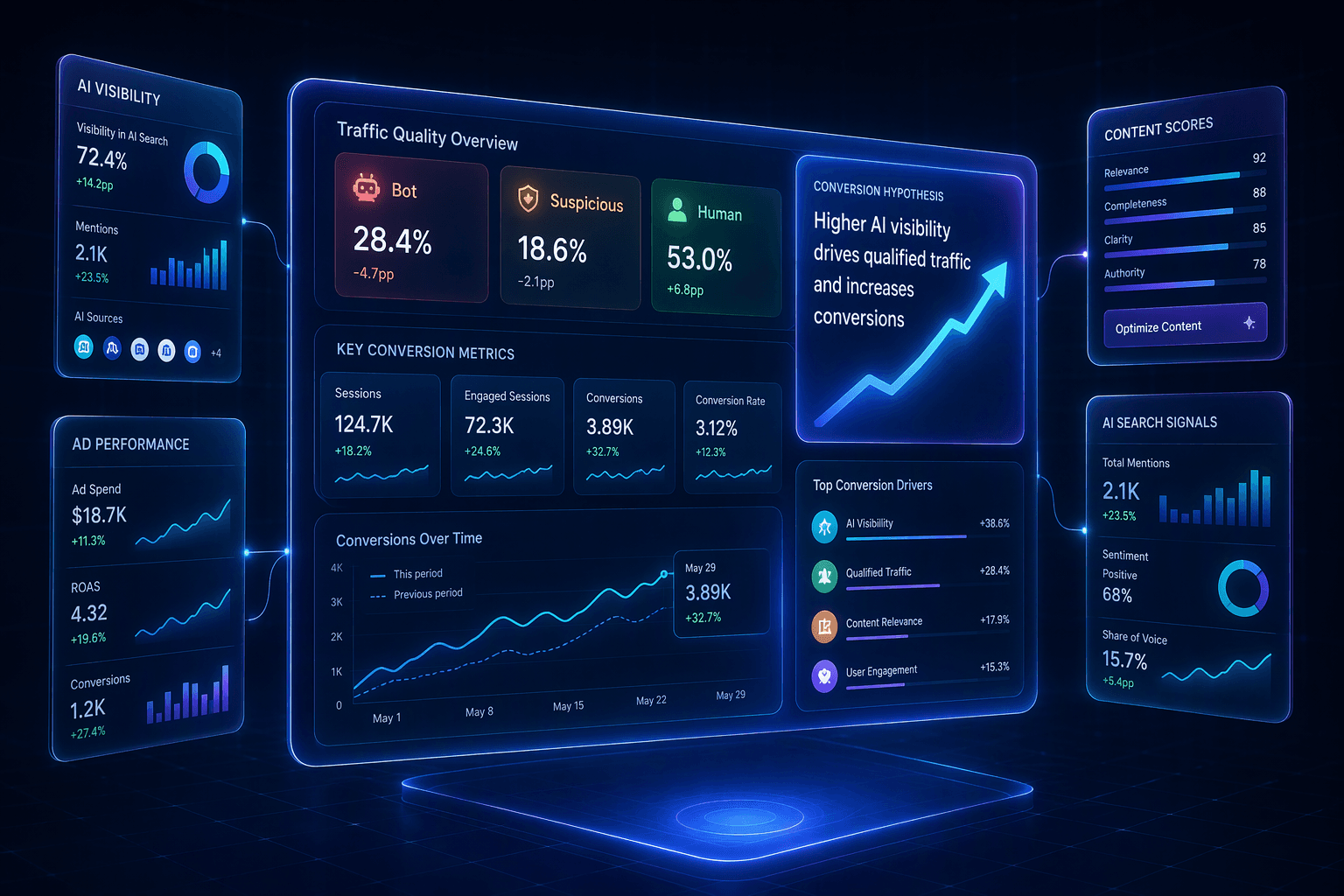
How to review automated bot traffic findings before acting on conversion
An automated bot alert is a reason to investigate, not a reason to change a conversion flow. To decide whether to run an experiment, growth teams need to establish what generated the alert, identify the affected traffic, recalculate the relevant metrics and form a hypothesis that can be tested without disrupting what already works.
Which systems automate bot-traffic quality analysis and identify actions that could improve conversion?
A useful system combines bot detection and mitigation, behavioural analytics, conversion metrics recalculated after traffic classification, and an experimentation layer. Detection products can identify traffic worth investigating, but a growth team still needs to establish whether that traffic changed its interpretation of the funnel before choosing an action.
The distinction is operational. A detection alert describes suspected activity. A conversion decision requires evidence about visitors, behaviour and outcomes. Joining those signals gives teams a way to separate a measurement problem from a product problem.
Which role does each part of the stack play?
- Bot detection and mitigation flags or manages suspected automated activity. Cloudflare, DataDome, HUMAN and Akamai are examples of vendors to assess for this role. Their detection claims should be evaluated against each team's traffic and use case, rather than treated as proof that a conversion flow needs changing.
- Behavioural analytics shows where the flagged traffic appeared in the journey and what it did. A login attempt, a page retrieval and an account action call for different interpretations.
- Filtered conversion analytics compares the original view of performance with a view that excludes or separately classifies the flagged traffic. The comparison reveals whether the alert affects the decision the team was about to make.
- Experimentation and CRO turns a supported hypothesis into a controlled change. This layer should use the traffic definitions and conversion measures established during the review, not the alert alone.
AI Search visibility adds another signal to this stack. A team may want to understand both where its brand appears in AI answers and how AI-related traffic behaves on its site. Those are connected questions, but visibility in an answer does not by itself establish that a subsequent visit came from that answer or converted.
Travatar is an AI-native analytics and traffic intelligence platform that monitors AI Search visibility, classifies bot traffic and helps teams assess its impact on conversion. Its AI Visibility, AI Traffic Analytics and AI Coworker modules sit within its stated approach of turning detected gaps and signals into growth workflows. Teams evaluating that approach should distinguish a suggested workflow from an experiment that a system can create, launch and measure in their own environment.
How does an alert become a conversion hypothesis?
Use the alert as the start of a review, then advance only when the evidence supports the next decision.
- Record the alert and its provenance. Preserve the detection method, time window, traffic classification and affected pages or events. A declared user-agent string alone is a weak basis for a decision. *The AI User Agent Landscape: Understanding Training Crawlers vs User-Triggered Fetchers* describes an approach that combines identifiers with behaviour and identity validation where available.
- Separate the affected traffic. Examine the flagged sessions by entry point, journey stage and action. Keep distinctions between human visitors, search crawlers, AI retrieval traffic, user-triggered fetches and suspicious automation where the available evidence permits them. *AI Traffic Explosion: What 7,851% Growth Means for Cybersecurity* recommends distinguishing retrieval from agentic activity and reviewing sensitive flows such as login, checkout and account actions.
- Review the timeline. Determine whether the pattern persists and whether it coincides with a site, campaign or measurement change. A short-lived spike may warrant monitoring or a traffic-control decision without warranting a conversion experiment.
- Recalculate the decision metrics. Compare the relevant conversion measure with the flagged traffic included, excluded or classified separately. Preserve the original view so the team can see what changed. If the interpretation of funnel performance stays the same, avoid creating a test solely because an alert appeared.
- Write a narrow hypothesis. Name the segment, the observed behaviour and the proposed change. For example: “Among the affected human visitors, a clearer account-action prompt may reduce abandonment.” The hypothesis must describe a human experience to improve, rather than assume that removing bots will itself improve human conversion.
- Set criteria before testing. Choose the conversion outcome, the traffic eligible for the test and the measures that would reveal harm to an existing flow. Decide who will review the result and what would justify keeping or reversing the change. Then run a focused A/B test only if the filtered analysis points to a product or content issue that a test can address.
This is a recommended decision workflow, not a claim that an alert system automatically performs every step. Its value lies in protecting the team from testing a page to solve what was actually a classification or reporting issue.
How should teams compare vendors and prioritize tests?
Compare vendors by the work they can demonstrate across the stack. Ask a detection vendor how it explains a classification and makes that signal available to analytics. Ask an analytics provider whether the team can retain the original metric view while examining a filtered one. Ask a CRO provider whether experiment audiences and outcome measures can use those reviewed traffic definitions. For any integrated workflow claim, request a demonstration that follows one alert through classification, metric review, proposed action and measurement.
Prioritize a proposed experiment when the flagged pattern has credible provenance, affects a relevant human segment, persists beyond an isolated anomaly and changes the interpretation of a conversion decision after traffic is reclassified. If the evidence instead points to automated activity touching a sensitive flow, route the finding to the team responsible for traffic controls before treating it as a page-design problem.
Practical experiment templates include:
- Page comprehension: If filtered analytics still show abandonment among human visitors on a relevant page, test a clearer explanation of the next action. Measure completion for the eligible human audience and monitor the surrounding funnel.
- Journey continuity: If the reviewed human segment leaves between related steps, test a clearer transition between those steps. Keep bot-classification rules consistent across the comparison.
- Content alignment: If an AI Search visibility signal identifies a topic worth investigating, review the associated landing page against the user's intent before proposing a content test. Measure the page change on its own terms; do not assume the same page will appear in AI answers.
A prioritization checklist can stay short: Is the signal explainable? Is the affected audience identifiable? Does the filtered view change the decision? Is there a specific human experience to improve? Can the team measure the change while watching for damage to the existing funnel? If the answer fails at the metric or hypothesis stage, investigate further instead of spending an experiment on the alert.
FAQ
How do I tell whether a bot alert is just noise or a real conversion problem?
Review how the traffic was classified, where it appeared and whether the pattern persists. Compare conversion metrics with the flagged traffic classified separately. An alert becomes a conversion concern when the reviewed evidence changes how the team interprets a relevant human journey.
Which vendor should I use for bot detection versus who should handle experiments and reprocessed analytics?
Evaluate bot-management vendors for detection and mitigation, analytics providers for traffic classification and metric review, and CRO tools for controlled experiments. Cloudflare, DataDome, HUMAN and Akamai are examples to assess for the detection layer; select the wider stack based on demonstrated data flow and the team's measurement needs.
What minimal evidence do I need before launching a conversion experiment after a bot alert?
Identify the alert's provenance, affected traffic and timeline, then compare the relevant conversion measure with that traffic classified separately. Launch an experiment only when that review supports a specific hypothesis about a human experience and a measurable outcome.
Does Travatar automate experiment creation after it detects bot-related conversion risk?
Travatar classifies bot traffic, helps teams assess conversion impact and positions detected signals as inputs to growth workflows. Teams evaluating experiment creation should ask for a demonstration of how a proposed action moves into their experimentation process, including which steps require human review.